
Mad in Pursuit Notebook
The Conversation: Finding Samuel Newham Sr.
Whispers of doubt
 “I thought you already solved that case!” Was that my dad whispering to me from the great beyond?
I took a drink of coffee and shook my head. Outside, snow was falling and the world was gray.
“But it’s such a great story. Samuel Newham disappears. You find him convicted of cattle theft and exiled to a life sentence in Tasmania. I love a family rogue!” Definitely Dad.
It was a good story, for sure. Samuel Newham Sr. (my 3x great-grandfather) [1] had disappeared from his family in the English Midlands sometime between the birth of his fourth child Sam Jr. (my 2x great-grandfather) and the 1841 census. For years, the only clue was a conviction record indicating a Samuel Newham's "transportation" to Tasmania. Pursuing that lead, I found a booklet: “The Good Shepherd; or, a Short Account of the Life and Death of Samuel Newham, Who Died at Somercotes, near Ross, in Van Diemen’s Land, on the 26th September, 1849.” The booklet told of a drunkard convict’s religious awakening and redemption under the ministry of Reverend Butters. Before his death, Newham was known for his piety and was pardoned of his crime.
Yes, I thought I had solved the case with an amazing story.
“Something’s not right about it," I said to Dad. "All the convict records point to Samuel Newham being single, born of an estate owner in Nottinghamshire. No mention of him being a family man. Doesn’t feel right. I need further confirmation.”
“There’s a hint.” I sensed my dad nudging me as I looked at Ancestry records.
“Right.” It was an 1825 baptismal record for Sam’s daughter Jane. A notation on the handwritten record reminded me that Sam was a wheelwright by trade—a specialized carpenter who made the wheels that kept carriages and wagons on the road.
“That bothers me too,” I said. “Convict Sam was referred to as a 'laborer,’ which usually means strong back, not skilled hands.”
In a column next to the baptismal record, there were several other records to check. More baptismal records. One of them was a baptismal record for Sam himself—born of Mary Hames and Edward Newham, wheelwright.
“Oh, that has to be our guy—papa was a wheelwright like Sam, not some big estate holder. Of course!”
More records about Edward and Mary clarified her maiden name as Eames, not Hames.
I continued working through the list of suggestions.
“You skipped a record,” Dad said.
“That’s a U.S. record. As far as I can tell, the Newhams all kept to their villages in the Midlands.”
He pulled up a heavenly chair and sat shoulder-to-shoulder with me. “Check it anyway. Go on,” he said.
I clicked on the U.S. Federal Census Mortality Schedules for the year ending in June 1850. The town was Jersey City, New Jersey.
There was “Saml Newham,” age 51, born in England, dead in July 1849 after a three-month bout with heart disease. Occupation: wheelwright.
OMG!
“That’s him! It must be him!” Dad whispered. “Look, there’s an 1840 census record.”
From cattle thief to rogue?
The 1840 U.S. Census was not very informative. It named only the head of household. Yet there was our Samuel Newham in Jersey City. Curiously, the household listing included one female. Hmmm.
“Maybe there’s a ship’s record?”
I jumped on the idea. There was! On April 6, 1830, the steam-driven mail packet St. George docked in New York with about 65 passengers. On board was Samuel Newham, wheelwright.
I pulled up the Newham records.
Just five years before, in 1825, Sam had married Charlotte Miller of Great Oakley, Northamptonshire.
Six months later, their daughter Jane was born. (I’ve stopped being surprised by “premature” babies in our family tree.) Seventeen months later, they had their son Edward. Another seventeen months—Mary Ann was born. When Sam boarded the St. George in Liverpool, Charlotte was eight months pregnant with Samuel Jr., my dad’s great-grandfather.
Could this really be my ancestor?
We stared at the screen. More New Jersey records popped into the suggestions column.
“Look, a will!” Dad made me look.
It was the transcript of a will apparently written on Sam’s deathbed, July 6, 1849.
Item. I hereby direct my Executors to rent the house, shop and premises where I now reside on Newark Avenue and the lot now in the occupation of James Wilson, on Warren Street for the best price that can be got for the same, and the rent to pay over to my wife Mary during her natural life.
Item. I give and devise my house and lot on Newark Avenue where I now reside and my lot on Warren Street now in the occupation of James Wilson to my three children Jane, Mary Ann, and Samuel now living in Northhamptonshire [sic] England. To have and to hold this same to them, their heirs and assigns, equally to be divided between them share and share alike, after the death of my said wife Mary.
My heart leapt. It is himself. Jane, Mary Ann, and Samuel were the three surviving Newham children.
So, Sam had left them. Yet he was in touch—enough to know about the birth of Sam Jr., enough to know the sad news of Edward’s death at age 10. He had prospered in New Jersey and wanted his wealth to go to them.
He did not mention his wife Charlotte. [2] The question loomed: who is this wife Mary?”
Life in Jersey City
The record surfaced immediately. On November 25, 1835, Samuel Newham married Mary Kingsland in Bergen, New Jersey. A bigamist!
“Look it up,” my dad said, “ but I don’t think divorce was available to commonfolk in England during that time.”
“Divorce or not, that’s a harsh thing to do—to leave a pregnant wife and three babies,” I said.
“Maybe his intentions were good. Maybe he thought he’d make his fortune in America and return home. Or send for the family. Jersey City was right across the Hudson River from New York City.”
I checked. Yes, Jersey City was a transportation boom town and teeming with immigrants.” I pulled up an old map. Newark Avenue and Warren Street were just blocks from the river.” (Click on the map below to enlarge it.)

It was time to pour myself a glass of wine. I wondered what could have been going on in England that might have driven Samuel away.
Edward Newham
Wine poured, I found myself in the British Newspaper Archive on Find My Past. I narrowed the search down to Northamptonshire in the 1820s, but it all looked like a gigantic mass of small print.
“Search on Newham,” Dad said.
I found this: an auction. May 4, 1829. Everything belonging to Edward Newham, Sam Sr.’s father, was being auctioned off, from household to business. It appears he was not only a wheelwright but a grocer.
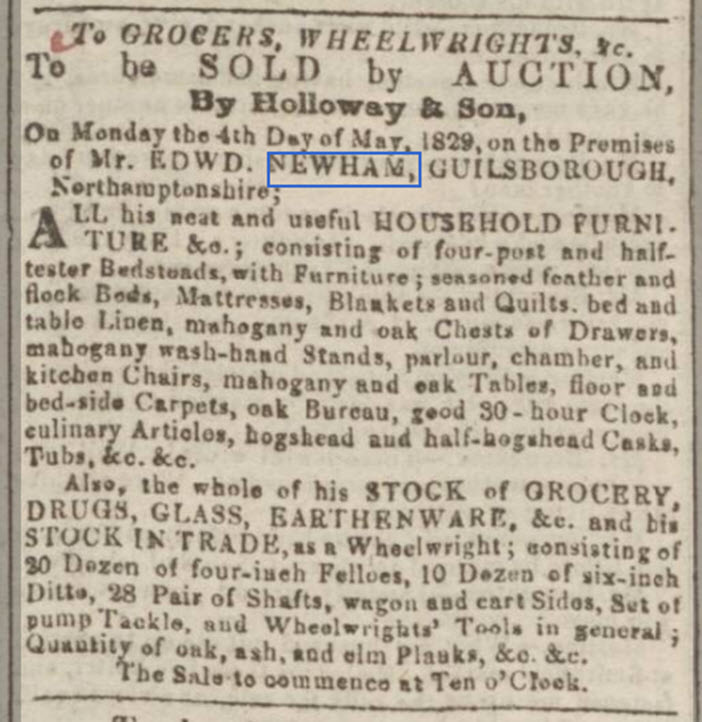
My goodness. I assume Edward has died. (I can't locate a record.) Sam’s brother John was the oldest son. Did he sell the business out from under Sam and impoverish Sam’s family? Or did he sell his father’s belongings to give each of the three (or more?) living brothers a nestegg? Did Sam use his inheritance to pay for his passage to New Jersey? So many questions!
As I pondered the possibilities, Jim stirred from his nap.
“What are you mumbling about over there?” he asked.
“What?”
“Who are you talking to?”
“No one,” I said.
My dad was gone. And the magic, gone with him.
***
I sit here now, wine again poured. So there were two Samuel Newhams, born six days and a few miles apart. Both of them died in 1849, at the age of 51. Sam #1 was a reformed thief, an exile-turned-religious-zealot. An interesting character to be sure. But Sam #2 is mine. Talented, skilled, ambitious, prosperous, and a cad to Charlotte and his children.
I want to know more.
Notes
[1] For clarity, I'm referring to Samuel Sr. and Samuel Jr. Those titles aren't part of any official record.
[2] The 1841 English census shows Charlotte supporting her children with lace-making.
13 Mar. 2023, revised 14 Nov 2025
Books from Mad in Pursuit and Susan Barrett Price: KITTY'S PEOPLE: the Irish Family Saga about the Rise of a Generous Woman (2022)| HEADLONG: Over the Edge in Pakistan and China (2018) | THE SUDDEN SILENCE: A Tale of Suspense and Found Treasure (2015) | TRIBE OF THE BREAKAWAY BEADS: Book of Exits and Fresh Starts (2011) | PASSION AND PERIL ON THE SILK ROAD: A Thriller in Pakistan and China (2008). Available at Amazon.