Mad in Pursuit Notebook
 Little Orphan Girls
Sometimes sad stories get sadder.
I've been piecing together the history of my grandmother Kitty Mom's family by looking at old census data. Her mother Maggie died in 1903, with 7 young children. And we know her husband Moses had a hard time holding it all together.
One day in 2005, I dug deeper into the 1910 Census. Moses was living on Lexington Avenue at the time with his two teenage sons, Moses Rafael and Joseph. My grandmother, the 19 y.o. Catherine, had flown the coop by that time, was boarding with the Flynn family, and working as a telephone operator.
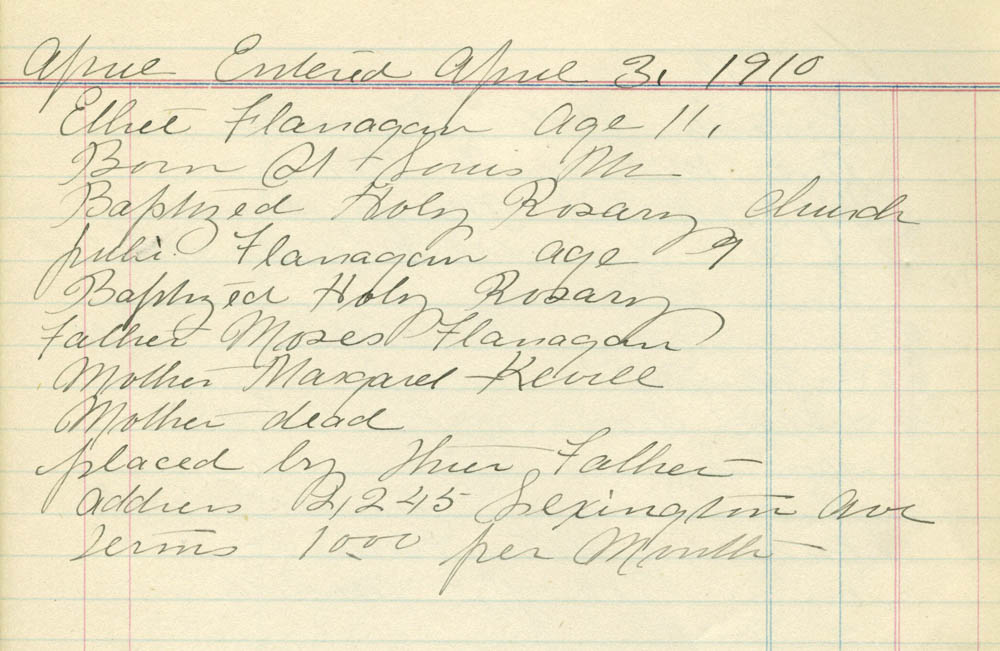
Where were the youngest children? I decided to search for "Ethel." She popped up immediately, along with her little sister Loretta Julia. At the ages of 9 and 11, both were "inmates" of the Guardian Angel Industrial School. It sent a shiver down my spine. (In 2016, I was able to get their placement document from the Daughters of Charity archive -- the image above [1].)
Of course I wanted to see what kind of institution they were in.
I found an interesting article on St. Louis Orphanages. It explains that these institutions proliferated during the waves of Irish and German immigrants in the late 19th century. The population of orphans grew until 1925.
I don't like to think that these two little girls were completely abandoned. According to the author Peggy Thomson Greenwood:
Half-orphans made up almost 23% of the
juvenile institutions’ population. A single parent, working 12 hours
a day and threatened with dismissal for single-day absence,
tardiness or illness could not work and raise children. It was these
children - neglected by circumstance, deprived, vulnerable, and
particularly susceptible to the temptations of crime that many
institutions were established to help. Homes would often contract
either the parent for some financial aid. Most of these children
were not abandoned to the institution. However, strict rules were
enforced through signed contracts. A parent or guardian who
neglected Sunday visits or became severely delinquent in the monthly
stipend could lose his/her children to adoption.
A growing number of children were committed to the institutions by
working parents. These were the boarders. By 1890, this group
represented about 24% of all children institutionalized. Both
parents working 72 to 84 hours a week were able to scrimp and save
and realize the American Dream. Parents would contract for the care
of their children - for a monthly fee to protect them from the
violence of the streets and to save them from the dangers of
neglect [Moses contributed $5/week toward each daughter's care]. As boarders, children would have weekly visitors and. often
return home for holidays. Although austere and regimental, children’
s homes offered a way to provide care and training to the children
of the upper-class poor. Both boarders and half-orphans helped
finance the operation of various institutions.
This is likely the institution where they were living:
The House of the Guardian Angels opened as an orphanage for girls ages seven to 12 in 1859. Under the direction of the Daughters of Charity, it quickly evolved into a half-orphanage and technical school. The school was self-supporting through the sewing skills of the residents. In 1906, the House of the Guardian Angels ceased operation as a technical school and became Guardian Angels Settlement, still in existence today.
Institutions are institutions. They are built with good intentions but are no place for kids. Whether the nuns were kind or not, life was not kind to these little girls.
By the end of 1919, Loretta was dead — bronchial pneumonia complicated by underlying diabetes.
My grandmother reported that Ethel was hit in the head with a frying pan by a stepmother and that she developed epilepsy. A child with special needs in a heartless world. In the 1920 Census, Ethel was in the City Sanitarium. She was there for the 1930 Census and, in spite of my grandmother's best intentions, she died there in 1956.
3.12.05 (last updated 12.10.05, 5.19.16 )
Notes
For the basics, check the summary of the Flanagan kids and the timeline of their demise.
Ethel Mary Flanagan
Born: 1899 St. Louis MO
Died: November 16, 1956 St. Louis MO
Loretta Julia Flanagan
Born: Jan 8, 1901 St. Louis MO
Died: September 10, 1919 St. Louis MO
[1] This facility was run by the Daughters of Charity. Their archives have now been collected at a single facility in Maryland. Find out more.
***
Books by Susan Barrett Price:
THE SUDDEN SILENCE: A Tale of Suspense and Found Treasure (2015) Thailand: lovers of ancient treasure tangle with international black markets. Delia Rivera pulls Martin Moon back into the game and their quest turns deadly. In paperback and Kindle editions.
TRIBE OF THE BREAKAWAY BEADS: Book of Exits and Fresh Starts (2011) Time after time, Mary asks herself: Do I go or do I stay? She finds her power in her ancestors: Smart women turn discontent into action. An illustrated memoir in paperback and Kindle editions.
PASSION AND PERIL ON THE SILK ROAD: A Thriller in Pakistan and China (2008) The twin forces of revenge and redemption drive Nellie MacKenzie and Taylor Jackson on a crazed adventure into the heart of Central Asia. They grapple with issues of ethics, trust, rage, and bitter heartbreak -- as well as the intrigue of the international antiquities trade. In paperback and Kindle editions.
Connect:


All pages in this website by Susan Barrett Price are licensed under a Creative Commons Attribution-Noncommercial-Share Alike 3.0 United States License.