mad in pursuit memoir notebook
DISPATCHED FROM THE intersection of yesterday and forever
- home >
- memoir index >
- this entry

 Scholarship Girl
I thought grade school was stupid. In large classes of up to 60 children, nothing about it was inspiring. Check problems: take a number, multiply it by 2, 3, 4, etc. then divide it by 2, 3, 4, etc. and come up with the original number. Diagramming sentences -- interesting the first thousand sentences or so but where was it leading? Religion: memorizing the Baltimore Catechism. Geography: endless months on the Central Farming Region: squared off, pale green diagrams of giant farms with no real explanation of sorghum. I vaguely remember writing book reports, but I don't remember reading books. Literature meant poetry with no meaning to 11-year-olds: hosts of daffodils, poppies in Flanders Field. In a rare act of rebellion, in eighth grade I refused to memorize any more dull poems. Sister Matthew would call on me and I'd stand up and say, "I don't know it." Was was she going to do? Only the boys got smacked.
Maybe I didn't like memorizing poems because you couldn't do it at the kitchen table while your mom was ironing, with the phone tucked between shoulder and ear talking with her mother. The radio on. Sisters in the next room watching cartoons. Roar of lawn mowers in the distance. Dogs barking.
It wasn't till high school that I discovered the power of learning, the thrill of being an Honors student, the glamour of the all-nighter. It turned me into a silent snob at home. Who were these people I was forced to live with? How had my whole family somehow missed the point of life? They seemed to live for nothing but fun. The men had pedestrian jobs and the women reared squadrons of annoying babies, so they squeezed in lots of beer and barbecues and hobbies that were either low budget (arguing over politics) or useful (turning basements of small houses into extra rooms). Not that I expected a debate over Thomas Aquinas or an explanation of the difference between Bach and Beethoven. I expected nothing. The only thing I wanted to get from them was away.
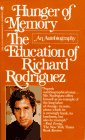
I just finished reading Hunger of Memory: The Education of Richard Rodriguez
 It is a rare bird -- the working class child
who falls in love with school. It causes anxiety in the child as his allegiance is torn between
worlds.
It is a rare bird -- the working class child
who falls in love with school. It causes anxiety in the child as his allegiance is torn between
worlds.
...the scholarship boy must move between environments, his home and the classroom, which are at cultural extremes, opposed. With his family, the boy has the intense pleasure of intimacy, the family's consolation in feeling public alienation. Lavish emotions texture home life. Then, at school, the instruction bids him to trust lonely reason primarily. Immediate needs set the pace of his parents' lives. From his mother and father the boy learns to trust spontaneity and nonrational ways of knowing. Then, at school, there is mental calm. Teachers emphasize the value of a reflectiveness that opens a space between thinking and immediate action.
My parents were not immigrants but belonged to the Irish-American working class. Though Frank McCourt (Angela's Ashes) was himself a scholarship boy, his family's world of wretchedness and alcoholism was also alien to mine. My grandparents were smart, skilled and hard-working. They doted on their children. They lived in close-knit neighborhoods where everyone's life became the perpetual source of wry and witty stories. They may not have sat around arguing the merits of Sartre over Kierkegard, but their whole-body intelligence can't be denied as they sewed up new spring coats, figured out how to build concrete steps down steep hills, and added second bathrooms to their tiny houses.
But the scholarship girl thought they were all as dull as the Baltimore catechism and flew away, away.
5.12.02